Drawing guide · five decisions
How to draw a hybrid animal that reads as one creature
Most hybrid animal drawings fail the same way. The fox head is fine, the eagle wings are fine, the lizard legs are fine, and the page still looks like a parts list. Nothing tells the eye which animal is carrying the weight.
The fix is not better rendering. It is five decisions made in order, before the first clean line: base body, borrowed parts, seams, silhouette, colour.
Choose the base body before you choose anything else
One animal has to supply the spine, the weight and the way the creature moves. Pick it first, and every later part has something to hang from. Pick it last, and you spend the drawing arguing with yourself about where the ribcage is.
“Anatomy is the cornerstone of successful creature design, whether the creature is real or imaginary.”Design Studio Press, describing Terryl Whitlatch's Science of Creature Design (2015)
The three skeletons below are the three most common bases. Each one gives you something for free and demands something in return.


Borrow parts for a reason, not for decoration
Every borrowed part should answer a question the base body cannot. What does this creature eat? How does it get away? Where does it sleep? A part that answers nothing is ornament, and ornament is what turns a creature back into a list. Nature has already answered most of those questions more than once; the guide to believable creature design shows how to use those repeat answers as a check on your own.
“While creating a new creature it's helpful thinking about reality and then modify it.”Nadia, Creating creatures by combining animals, CLIP STUDIO TIPS
The hybrid animal generator splits a creature into eleven slots, which happens to be a good checklist. Go down it and give each borrowed slot a job:
- Nose and mouth — decided by diet. Grazer, hunter or filter-feeder — the jaw says which.
- Legs, feet and claws — decided by movement. Running, climbing, digging and swimming each want a different foot.
- Texture — decided by environment. Scales for heat and abrasion, fur for cold, bare skin for water.
- The extra feature — decided by danger. A horn, a frill, a stinger — one warning, not three.
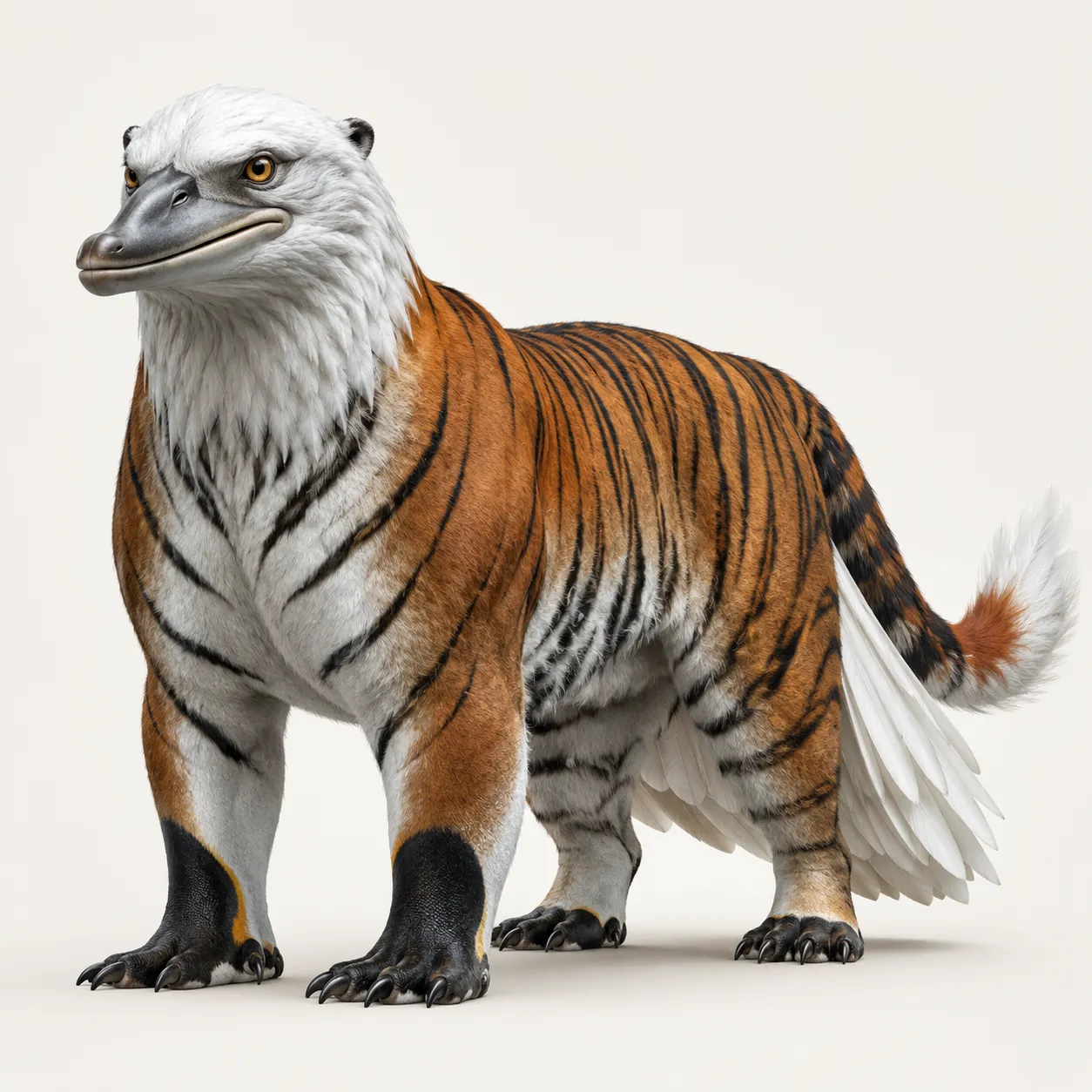
A working limit: at most two loudparts. The tiger above borrows an eagle head and an eagle tail. Everything else stays tiger, which is why it still looks like an animal rather than a costume. The griffin is the oldest proof of the rule: a lion that borrows only an eagle's head and wings, and has read as one creature for nearly three thousand years. The guide to mythical hybrid creatures writes that recipe out, with seven more.
Put the seams at the joints
A seam is where one animal stops and the next begins. Real bodies already change material at the joints: fur thins at the wrist, feathers stop at the ankle, scales give way at the neck. Put your seams in the same places and the eye accepts them. Put a seam halfway down a shin and the leg looks glued on.
Two more rules at the seam. Scale the borrowed part to the base: a fox skull on a stork body is drawn at stork-neck width, not fox width. And let the base animal win the neck. A bird's neck is long and S-curved; a fox's is short. You get one, not an average.
Fill it black and see if it still reads
This is the oldest test in character design, and it works on creatures just as well.
“When designing characters, artists often use a silhouette to test whether the character's basic design ‘reads’ to the audience.”The Walt Disney Family Museum, Tips & Techniques: Silhouette
Reads. You can find the head, the crest, the tail and the legs without a single interior line.
Does not read.Four animals' worth of parts stacked in front of each other, and the outline says “rock”.
Do it early, on the rough. Fill the sketch black with a marker or a layer, then ask three questions: which end is the head, where are the two loud parts, and is there one mass that is clearly the body. If any answer is “not sure”, move a part into the open air before you draw any detail.
Give it one colour logic
Colour is where a nearly finished hybrid animal drawing slides back into a parts list. Painting each part in its donor's colours is the same mistake as the mid-shin seam, made with a brush.
- Take the palette from the base animal and let it run across the seams. Tiger orange continues onto the borrowed legs.
- Let pattern follow form, not part boundaries. Stripes wrap the ribcage the way they would on the real animal; they do not stop where the eagle begins. The guide to why animals have stripes and spots shows the rule nature follows: spots on the wide body, stripes where it narrows.
- Spend your one exception on a loud part. The eagle's white head keeps its white, because that contrast is the whole point of borrowing it.
Practice
The fifteen-minute hybrid drill
Five decisions are easier to practise on a creature you did not have to invent. The generator can hand you one that already obeys the two-loud-parts rule.
- Open the generator and set weirdness to 1 or 2.Low weirdness keeps the donor animals related, so the base body is easy to find.
- Lock the body slot, then reroll the rest.Keep rolling until only one or two borrowed parts stand out. That is your recipe.
- Two minutes: the base skeleton.Spine, ribcage, hips, four columns or two. Nothing borrowed yet.
- Eight minutes: attach the parts at the joints.Neck, shoulder, hip. Scale each part to the base before you draw it.
- One minute: fill it black.Head, loud parts, one mass. Fix whichever one fails.
- Four minutes: colour from the base.One palette, one exception.
Three ways a hybrid animal drawing goes wrong
Every part is loud
Six borrowed features compete and none wins. The silhouette turns into a rock. Cut back to two.
Seams in the middle of a limb
The leg changes animal halfway down the shin. Move the seam to the knee or the hip.
Colour by donor
Each part painted in its original coat. The eye separates them again. Paint from the base.
None of this is how nature does it, and that is worth knowing too. Real crosses like the liger or the mule come from closely related parents and inherit a blended body, not a grafted one. The page on real hybrid animals shows what that looks like with photographs, and the animal library is where to find a reference for any part you borrow. For a set of borrowings evolution already made, the guide to real animals that look fake shows nine species whose seams sit exactly where this method says they should.
Where this comes from
Sources for this guide
The method above is a working distillation of three sources. Each is worth reading in full; the quotations are theirs, the ordering is ours.
- Terryl Whitlatch, Science of Creature Design (Design Studio Press, 2015)
The publisher's description states the principle this guide is built on: anatomy first, then invention.
- The Walt Disney Family Museum, “Tips & Techniques: Silhouette”
A free education sheet on the silhouette test — fill the figure black and check whether it still reads.
- Nadia, “Creating creatures by combining animals” (CLIP STUDIO TIPS)
A working artist's walkthrough of a swan–toucan–anteater creature, including the diet and movement questions.